The Most Common Heart Rhythm Disorder and Why Knowing About It Protects Your Brain
Atrial fibrillation treatment (AFib or AF) is the world’s most common sustained cardiac arrhythmia. In India, it is estimated to affect between 5 and 8 million people—a number that grows with the aging of the population, the rising prevalence of hypertension and diabetes, and improving awareness and detection. Many of those millions do not know they have it. Their heart rhythm is abnormal, their stroke risk is elevated, and they are receiving none of the atrial fibrillation treatment that would protect them.
The most compelling reason to diagnose and treat AFib is not the symptom burden—though that can be severe. It is stroke prevention. Atrial fibrillation increases the risk of ischemic stroke by approximately five times compared to patients without the condition. AFib-related strokes are larger, more disabling, and more fatal than most other stroke mechanisms. In many cases, the first presentation of AFib is the stroke itself—a preventable catastrophe.
For patients, families, and every person with an unexplained irregular heartbeat or a history of stroke, understanding atrial fibrillation—what it is, how it is diagnosed, and how it is treated—is knowledge that genuinely changes outcomes.
What Happens in Atrial Fibrillation
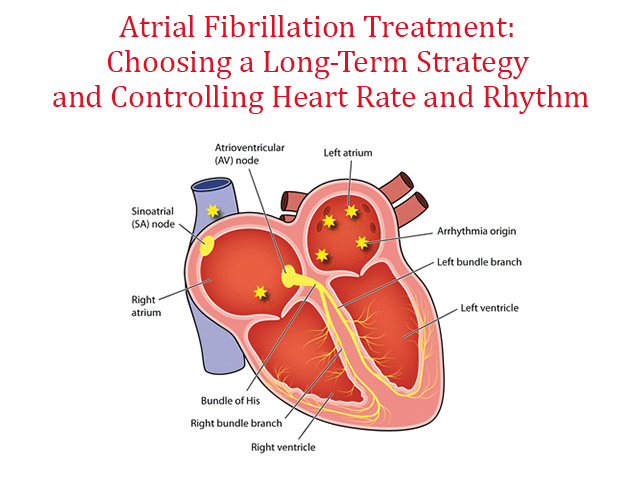
In normal heart rhythm, an electrical impulse originates from the sinus node in the right atrium and travels in an organized sequence through the heart, producing coordinated contraction of the atria followed by the ventricles. The result is a regular pulse.
In AFib, multiple chaotic electrical impulses fire simultaneously from different points within the atria — most often triggered by electrical activity around the pulmonary vein connections to the left atrium. Instead of contracting in a coordinated manner, the atria quiver. The ventricular chambers respond to these irregular impulses, producing an irregularly irregular heartbeat—the clinical hallmark of AFib, detectable on palpation of the pulse and confirming on an ECG.
Because the atria are not contracting effectively, blood pools—particularly in the left atrial appendage, a small blind-ended pouch of the left atrium. Pooled blood clots. A clot that forms here can break off, enter the systemic circulation, and travel to the brain, producing an embolic stroke. This mechanism is responsible for approximately 20 to 25% of all ischemic strokes—and a significantly higher proportion of strokes in elderly patients.
Also read: AFib and Brain Stroke: The Critical Connection Every Patient Must Know
Also read: Atrial Flutter vs AFib: Expert Diagnosis and Treatment in Hyderabad
Symptoms: The Wide Spectrum of How AFib Presents
Atrial fibrillation presents across an extraordinarily wide symptomatic spectrum. Some patients experience dramatic, distressing palpitations — a rapid, fluttering, or chaotic heartbeat that they are acutely aware of. Others have breathlessness, fatigue, or reduced exercise tolerance that they may attribute to aging or deconditioning. Still others have dizziness or near-fainting episodes during episodes of very fast or very irregular heart rate.
A significant minority of AFib patients are completely asymptomatic. Their arrhythmia produces no noticeable symptom, is not detected on routine medical visits, and continues silently until it causes a stroke. This is why screening for AFib in patients with risk factors (older age, hypertension, diabetes, heart failure, and prior stroke) is increasingly recommended by international cardiology guidelines and why unexplained stroke should always prompt a thorough cardiac rhythm evaluation.
Diagnosing AFib: From Pulse to Holter
The diagnostic investigation for AFib begins with an ECG — a 12-lead recording of the heart’s electrical activity. AFib produces a characteristic pattern: absence of P waves, irregular ventricular rhythm, and an undulating fibrillatory baseline. A routine ECG confirms continuous AFib reliably.
The challenge is paroxysmal AFib — arrhythmia that comes and goes in episodes that may be brief, infrequent, and entirely asymptomatic between events. A patient with paroxysmal AFib who has a normal sinus rhythm when the ECG is taken will receive a normal ECG report that is technically accurate but clinically misleading.
Holter monitoring — a portable ECG device worn for 24 to 72 hours continuously — significantly improves detection. For patients with less frequent episodes, extended monitoring using 30-day event recorders or implantable loop recorders (small devices inserted under the skin that record rhythm continuously for up to three years) is used. Implantable loop recorders have transformed the detection of paroxysmal AFib in patients with unexplained stroke, revealing occult arrhythmia in a substantial proportion of cases previously classified as cryptogenic stroke.
Alongside ECG and rhythm monitoring, the AFib evaluation includes echocardiography (to assess cardiac structure, left atrial size, and left ventricular function), thyroid function tests, and relevant metabolic blood tests to identify treatable contributors to the arrhythmia.
The Three-Pillar Framework of Atrial fibrillation treatment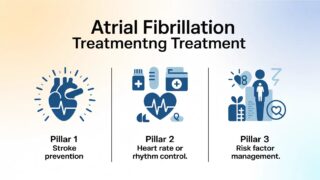
Atrial fibrillation in India, as internationally, rests on three interconnected pillars:
Pillar 1 — Stroke Prevention. This is the most clinically critical component for the majority of AFib patients. The CHA₂DS₂-VASc score — which accounts for age, sex, heart failure, hypertension, diabetes, prior stroke, and vascular disease — quantifies each patient’s annual stroke risk and guides the decision to anticoagulate. Direct oral anticoagulants (DOACs) — rivaroxaban, apixaban, edoxaban, and dabigatran — are now the preferred anticoagulants for most patients with non-valvular AFib, offering reliable stroke prevention without the monitoring burden and dietary interactions of warfarin.
Pillar 2 — Heart Rate or Rhythm Control. Rate control — slowing the ventricular response to AFib using beta-blockers, calcium channel blockers, or digoxin — is appropriate for patients with acceptable symptom control, or those with longstanding persistent AFib. Rhythm control — restoring and maintaining normal sinus rhythm — is pursued when symptoms remain significant despite rate control, through antiarrhythmic medications, electrical cardioversion (a brief controlled electric shock under sedation), or catheter ablation (pulmonary vein isolation). Evidence from the EAST-AFNET 4 trial and CASTLE-AF now supports early rhythm control in many patients as a superior long-term strategy.
Pillar 3 — Risk Factor Management. Treating the conditions that drive AFib—hypertension, obesity, diabetes, sleep apnea, alcohol use—is now recognized as an integral part of AFib treatment. The RACE 3 trial demonstrated that intensive risk factor management significantly improves rhythm control outcomes. AFib management that focuses only on the arrhythmia, without addressing its drivers, produces inferior long-term results.
Choosing the Best Cardiologist for Atrial Fibrillation in India
Managing AFib well requires a cardiologist with comprehensive expertise across all three treatment pillars—not just arrhythmia knowledge, but depth in anticoagulation management, risk stratification, echocardiographic assessment, and the clinical judgment to navigate the evolving evidence base in a condition where guidelines are updated regularly.
Dr. Raghu is recognized as one of the best cardiologists in Hyderabad for atrial fibrillation in Hyderabad and India. His AFib program provides systematic risk stratification, evidence-based anticoagulation, individualized heart rate and rhythm management, and collaborative access to cardiac electrophysiology for patients where catheter ablation is indicated. Patients from across India and beyond consult his practice for AFib treatment that reflects the current highest standard of evidence-based cardiac care.
Contact Dr. Raghu’s team in Hyderabad through contact for an atrial fibrillation evaluation, stroke risk assessment, or AFib management review.