
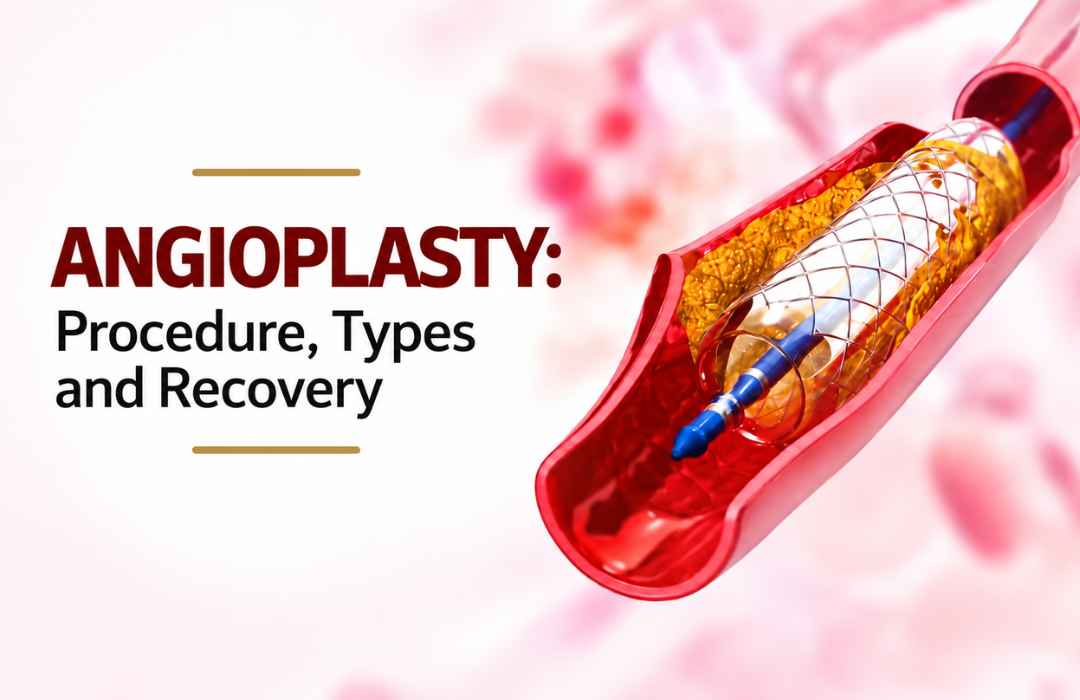
When a coronary artery is completely blocked, patients often want to know whether it can be reopened, what the procedure involves, and how long recovery may take. CTO Angioplasty in Heart treatment is a specialized form of coronary intervention used in selected patients with a chronic total occlusion. This guide explains what a CTO is, the main procedure approaches, who may be considered for treatment, recovery after CTO angioplasty, and why assessment by a Coronary Artery Disease Specialist matters.
What Is CTO Angioplasty?
CTO stands for chronic total occlusion. It refers to a coronary artery that has been completely blocked for a prolonged period. Over time, the body may develop smaller alternative blood vessels called collateral vessels that can supply some blood to the heart muscle beyond the blockage.
A CTO is different from a partially narrowed coronary artery. The blockage can contain hardened plaque and fibrous tissue, making it more technically challenging for a catheter and guidewire to cross.
CTO angioplasty, also called CTO PCI, is a catheter-based procedure that attempts to restore blood flow through the chronically blocked coronary artery. Whether it is appropriate depends on the patient’s symptoms, coronary anatomy, heart function, evidence of ischaemia or viable heart muscle, other coronary blockages, and overall health.
Current chronic coronary syndrome guidance emphasizes individualized assessment and shared decision-making when selecting a revascularization strategy.
Who May Be Considered for CTO Angioplasty?
Having a CTO does not automatically mean that angioplasty is required. Some patients may have adequate blood supply through collateral vessels and few or no symptoms, while others may have persistent symptoms or evidence that the blocked artery is affecting the heart muscle.
A Coronary Artery Disease Specialist may consider CTO PCI when factors such as the following are present:
- Persistent or recurrent angina despite appropriate medical treatment
Reduced exercise tolerance or symptoms affecting daily activities
Evidence of significant ischaemia related to the territory supplied by the blocked artery
Viable heart muscle that may benefit from improved blood flow
Coronary anatomy that is suitable for PCI
A clinical situation in which the expected benefits of revascularization outweigh its risks
For some patients, medication and lifestyle management may remain appropriate. In others, PCI or coronary artery bypass surgery may be considered. The decision is based on the individual rather than the blockage alone.
Types of CTO Angioplasty Procedures
The approach used during CTO PCI depends heavily on the location, length and characteristics of the blockage and the surrounding coronary anatomy.
Antegrade Approach
In an antegrade approach, the guidewire is directed toward the CTO from the usual starting point of the coronary artery.
This may be considered when the anatomy provides a suitable path through the occluded segment. The operator uses coronary imaging and procedural techniques to navigate the wire toward the distal part of the artery.
Retrograde Approach
A retrograde approach reaches the blockage from the opposite side of the occlusion. In selected cases, the guidewire can be directed through suitable collateral vessels to approach the distal portion of the CTO.
This can be useful when an antegrade strategy is difficult or does not provide a suitable route. It requires careful assessment of the coronary anatomy and specialized procedural expertise.
Hybrid CTO PCI
A hybrid approach uses more than one CTO PCI strategy depending on what happens during the procedure.
For example, the operator may begin with an antegrade strategy and change to another technique if the initial pathway proves unsuitable. This flexibility allows the procedure to be adapted to the patient’s anatomy rather than forcing every CTO into the same treatment method.
How Is CTO Angioplasty Performed?
Although CTO PCI is more complex than many routine angioplasty procedures, the overall process follows familiar catheter-based principles.
The procedure may involve:
- Detailed assessment: Previous angiograms and other cardiac imaging are reviewed to understand the blockage and surrounding vessels.
Arterial access: A catheter is introduced through an appropriate artery, commonly through the wrist or groin.
Guidewire navigation: Specialized guidewires are carefully directed toward and, when possible, across the chronic blockage.
Balloon treatment: Once an appropriate pathway has been established, balloon angioplasty can be used to widen the treated segment.
Stent placement: A coronary stent may be placed when appropriate to help maintain the opened vessel.
Final assessment: The result is checked before the catheters are removed and the patient moves to post-procedure monitoring.
The American Heart Association describes PCI as a catheter-based treatment that can open narrowed or blocked coronary artery segments, with patients monitored after catheterization for bleeding, blood pressure, heart rhythm and other concerns.
CTO Angioplasty vs Bypass Surgery
CTO angioplasty and coronary artery bypass grafting (CABG) are different ways of restoring blood flow to the heart.
CTO PCI is performed through catheters and generally does not require an open surgical incision. CABG uses blood vessels from another part of the body to create a new route around blocked coronary arteries.
Neither option is automatically appropriate for every patient. The choice may depend on:
- Number and location of blocked arteries
Complexity of coronary disease
Heart function
Diabetes and other medical conditions
Surgical risk
Coronary anatomy
Previous procedures
Patient preferences and expected outcomes
For complex coronary disease, a cardiology team may compare PCI, surgery and medical treatment before recommending a strategy. The 2024 ESC guidance specifically emphasizes selecting the revascularization approach according to the patient’s clinical profile, coronary anatomy, procedural factors and preferences.
CTO Angioplasty Recovery: What to Expect
Recovery after CTO angioplasty varies. A straightforward catheter-based procedure may allow relatively rapid return to normal activities, but CTO PCI can require more extensive procedural planning and monitoring than routine PCI.
First 24 Hours
Immediately after the procedure, the medical team monitors the patient’s heart rhythm, blood pressure and catheter access site. The access area is checked for bleeding, swelling or other complications.
First Few Days
The patient is generally advised to rest and gradually resume normal activities according to the treating team’s instructions. Care of the wrist or groin access site is particularly important.
Following Weeks
Activity can usually increase progressively when medically appropriate. Some patients may also be advised to participate in cardiac rehabilitation, depending on their overall cardiac condition and treatment plan.
Follow-up appointments are important for reviewing symptoms, medications, risk factors and overall cardiovascular health.
Medicines After CTO Angioplasty
Medication is an important part of care after coronary intervention, particularly when a stent has been implanted.
Depending on the patient’s circumstances, prescribed treatment may include:
- Antiplatelet medication
Cholesterol-lowering medication
Blood-pressure medication
Anti-anginal treatment
Other medicines related to diabetes or cardiovascular risk
Patients should not stop or change prescribed heart medication without speaking with their treating clinician. Current ESC guidance includes antiplatelet therapy as an important component of treatment after PCI, with the regimen and duration individualized according to clinical and bleeding risk.
What Are the Risks of CTO Angioplasty?
CTO PCI is technically demanding and carries risks that need to be discussed before treatment. Potential complications can include:
- Bleeding or bruising at the catheter access site
Blood-vessel injury
Coronary artery perforation
Abnormal heart rhythms
Heart attack
Contrast-related complications
Need for additional intervention or, rarely, emergency surgery
Re-narrowing or repeat blockage
The exact risk depends on the patient’s health, coronary anatomy and procedural complexity. This is why careful pre-procedure planning and appropriate specialist assessment are important.
When Should a Patient Contact a Doctor After CTO PCI?
After cardiac catheterization or angioplasty, new or worsening symptoms should not be ignored.
Patients should seek medical advice for concerns such as:
- New or worsening chest pain
Shortness of breath
Persistent or increasing bleeding from the access site
Significant swelling or pain around the access site
Dizziness or fainting
Fever
A very fast, very slow or irregular heartbeat
The American Heart Association advises patients to report chest pain, shortness of breath, significant access-site swelling or bleeding and other concerning symptoms after cardiac catheterization.
If severe chest discomfort, breathing difficulty or other possible heart-attack symptoms occur, emergency medical care should be sought immediately rather than waiting for a routine appointment.
Choosing a Specialist for CTO Care
Because CTO PCI can be more technically complex than routine angioplasty, patients may want to ask about the specialist’s experience with chronic total occlusions and the range of treatment options available.
Useful questions include:
- Is the blockage suitable for CTO PCI?
What approach is being considered?
Are there alternative treatment options?
Would bypass surgery or medical management be more appropriate?
What complications are relevant to the patient’s anatomy?
What follow-up will be required after treatment?
Patients seeking a Top Cardiologist in Hyderabad can review the available cardiac services and arrange a specialist consultation through Dr. C. Raghu’s website.
Related Cardiac Conditions and Specialist Care
Some patients undergoing coronary evaluation may also have other cardiovascular conditions. For example, older adults may have coronary artery disease alongside aortic valve disease, while unexplained breathlessness may require assessment for several possible causes.
For patients with significant aortic stenosis, a TAVI Expert in Hyderabad may evaluate whether transcatheter aortic valve replacement is appropriate. Similarly, patients with suspected pulmonary embolism require a separate diagnostic pathway and, when confirmed, appropriate Pulmonary Embolism Treatment in Hyderabad.
These conditions should not be assumed to be related to a CTO. Each requires appropriate clinical evaluation.
Also read this : What is coronary angioplasty? Everything you need to know
Moving Forward After a CTO Diagnosis
A chronic total occlusion can sound alarming, but the diagnosis does not by itself determine the treatment. Some patients may be managed with medication and risk-factor control, while selected patients may benefit from CTO PCI or another revascularization strategy.
For someone experiencing persistent chest discomfort, reduced exercise tolerance or other concerning cardiac symptoms, the practical next step is a detailed evaluation rather than delaying care or assuming that every complete blockage requires the same procedure.
Patients in Hyderabad, Telangana, Chennai and elsewhere in India can learn more about CTO Angioplasty in Heart and coronary artery disease care by visiting Dr. C. Raghu’s website and arranging an appropriate specialist consultation. The goal is to understand the anatomy, available options and expected recovery clearly so that treatment decisions can be made with the treating cardiac team.
Find how an CTO Angioplasty in Heart in Hyderabad can help improve your heart health and quality of life. Consult Dr. C. Raghu, an experienced interventional cardiologist and TAVI Expert in Hyderabad, specializing in structural heart disease at Yashoda Hospital. Schedule your consultation for personalized cardiac care.