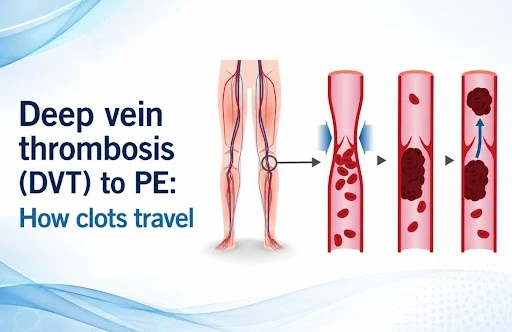
Deep vein thrombosis When someone develops sudden leg swelling, unexplained pain, or breathlessness that comes on quickly, the link between deep vein thrombosis (DVT) and pulmonary embolism (PE) becomes clinically significant. Knowing how a clot forms in the veins, breaks loose, and travels to the lungs gives doctors and medical students a clearer framework for diagnosis and treatment. This article walks through that pathway, the warning signs at each stage, how these conditions are diagnosed, and the core principles behind DVT treatment and pulmonary embolism treatment.
What Is Deep Vein Thrombosis?
DVT refers to a blood clot that forms inside a deep vein, most often in the leg typically the calf, thigh, or pelvic veins. Depending on its size and location, the clot can partly or fully block normal blood flow through the vein.
Common signs include:
- Swelling in one leg
- Pain or tenderness in the affected limb
- A feeling of warmth over the area
- Redness or a change in skin color
- Sometimes, no noticeable symptoms at all
That last point matters clinically DVT doesn’t always announce itself. In some cases, a clot stays silent until it embolizes and causes problems elsewhere.
How Does a Clot Travel From the Leg to the Lungs?
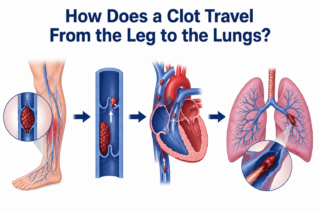
A Deep vein thrombosis becomes a pulmonary embolism when a piece of the clot breaks free and travels through the bloodstream.
The general route looks like this:
Deep leg veins → inferior vena cava → right atrium → right ventricle → pulmonary arteries → lungs
Once a fragment of the clot detaches, it’s called an embolus. It moves through the venous system toward the right side of the heart and from there into the pulmonary circulation. If it becomes lodged in a pulmonary artery, that’s a pulmonary embolism.
How serious the resulting PE is depends largely on the embolus’s size, where it lodges, and how much cardiopulmonary reserve the patient has. A large clot can meaningfully disrupt blood flow through the lungs and put real strain on the right side of the heart.
Also read: Deep vein thrombosis treatment | Cardiologist in Hyderabad
Why Early DVT Treatment Matters
Once DVT is diagnosed or strongly suspected, the treatment goal is to stop the clot from growing and to lower the risk that a piece of it breaks away.
Anticoagulant medication is the backbone of DVT treatment. These drugs don’t dissolve the existing clot directly, but by limiting further clot formation, they give the body time to break down the thrombus on its own.
The specific anticoagulation plan, which drug and for how long,, is tailored to the individual, taking into account:
- Where the clot is and how extensive it is
- The patient’s bleeding risk
- Any history of prior DVT or PE
- Whether cancer or another underlying condition is driving clot formation
- Recent surgery, hospital stays, or long periods of immobility
- Other relevant health conditions
In other words, treatment isn’t one-size-fits-all just because a clot is present; it has to match the patient’s broader clinical picture.
Recognizing When Deep vein thrombosis Has Become PE
Pulmonary embolism should be on the radar any time a patient with known or suspected DVT suddenly develops heart or lung symptoms.
Typical warning signs of PE include:
- Sudden or unexplained shortness of breath
- Chest pain that worsens with deep breaths
- A racing or irregular heartbeat
- Persistent cough
- Coughing up blood
- Dizziness or fainting
None of these symptoms is unique to PE on its own, which is exactly why proper clinical evaluation and testing are essential rather than guesswork.
A typical scenario: someone recovering from a long period of immobility first notices swelling in one calf. If they then develop sudden breathlessness and sharp chest pain that worsens with breathing, that combination should prompt urgent evaluation for DVT-related PE.
How Pulmonary Embolism Is Treated
The right approach to pulmonary embolism treatment depends on how sick the patient is, how much of the pulmonary circulation is blocked, and the risk that their condition could worsen.
Anticoagulation remains the mainstay for preventing further clotting. For patients who are hemodynamically unstable or have a more severe PE, more aggressive interventions may be warranted depending on the clinical picture and the resources available.
Diagnostic workup commonly includes:
- D-dimer testing in the right clinical context
- Compression ultrasound to check for DVT
- CT pulmonary angiography to confirm PE
- ECG and cardiac biomarkers to assess risk
- Echocardiography in select cases, to check how the right side of the heart is coping
The goal isn’t just to find the clot it’s to understand how dangerous it is and how urgently the patient needs treatment.
When to Involve a Pulmonary Embolism Specialist
A pulmonary embolism specialist becomes especially relevant in complex cases: an extensive PE, significant strain on the heart and lungs, or a situation where advanced procedures like catheter-based clot removal are being considered.
For patients or referring doctors searching for a top pulmonary embolism doctor, a pulmonary embolism specialist in India, or a pulmonary embolism doctor nearby, it’s worth prioritizing a clinician experienced specifically in venous thromboembolic disease, including catheter-based and multidisciplinary treatment options where they apply.
For clinicians, the key takeaway is that DVT and PE aren’t two unrelated diagnoses; they’re two stages of the same underlying disease process, venous thromboembolism, and should be assessed together rather than in isolation.
The DVT-to-PE Pathway, Step by Step
- A clot forms in a deep vein.
- Part of the clot breaks loose.
- The embolus travels through the venous system.
- It reaches the right side of the heart.
- It passes into the pulmonary arteries.
- It may block blood flow through the lungs.
- The result is a pulmonary embolism.
This chain of events is exactly why catching DVT early and treating it properly matters so much in preventing a potentially life-threatening complication.
Also read : Pulmonary Embolism in India: Emergency & Finding Specialist
When to Seek Specialist Care Urgently
Sudden breathlessness, unexplained chest pain, coughing up blood, fainting, or a noticeably fast heart rate in someone with known or suspected DVT calls for immediate medical attention. PE can be life-threatening, and it’s not something to wait out or try to manage without professional evaluation.
For patients dealing with complex DVT or pulmonary embolism, Dr. C. Raghu offers specialized cardiovascular care, including catheter-based treatment for venous thrombosis and pulmonary vascular disease.
If you or someone you know has suspected or confirmed DVT or pulmonary embolism, consult Dr. C. Raghu for a specialist evaluation and a treatment plan suited to your specific condition.