Coronary-angioplasty-2.webp

July 1, 2026

Coronary angioplasty: Your chest feels tight. You’ve been getting shortness of breath lately, especially when you climb stairs or walk briskly. You’re worried. Your doctor has mentioned something called coronary angioplasty, but you don’t understand what it is or whether you really need it.

You’re not alone. Many middle-aged people are facing coronary artery disease without fully understanding their treatment options. The term “angioplasty” sounds intimidating. The word “stent” makes you nervous. But here’s the truth: understanding what these procedures are and how they can help you is empowering. It gives you control over your health decisions.

Understanding Coronary angioplasty Artery Disease
Coronary angioplasty

Before we discuss angioplasty, you need to understand the problem it solves.

Your heart is a muscle that needs oxygen to work. Coronary arteries deliver oxygen-rich blood to your heart. These are the highways of your cardiovascular system. Over time, for various reasons—high cholesterol, high blood pressure, smoking, diabetes, and stress—fatty deposits build up inside these arteries. This buildup is called plaque.

Coronary artery disease happens when these arteries narrow. Blood flow decreases. Your heart struggles to get enough oxygen, especially during activity or stress. You feel chest pain. You feel exhausted. You feel vulnerable.

This is serious. Completely blocked arteries lead to heart attacks.

What Exactly is Coronary Angioplasty?

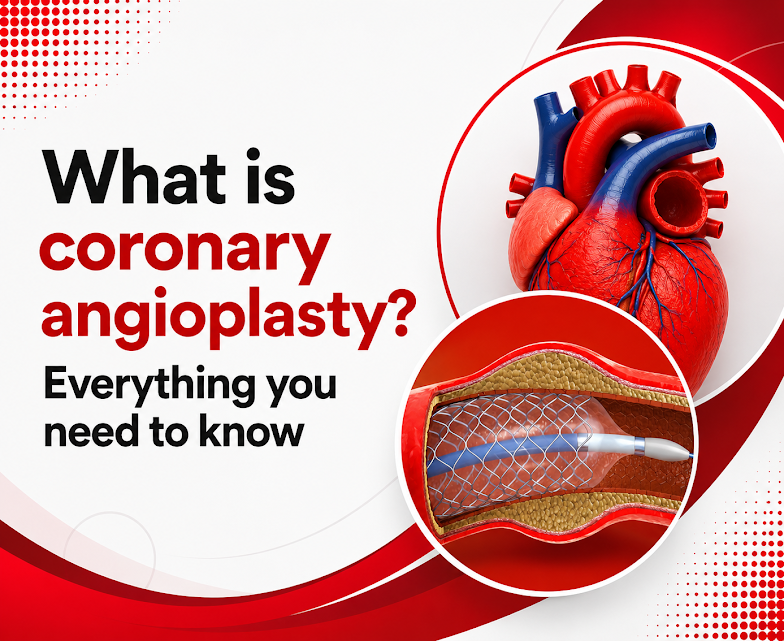
Let’s demystify this. Coronary angioplasty is a minimally invasive procedure that opens blocked or narrowed coronary arteries. It’s not surgery in the traditional sense—no large incisions, no general anesthesia, no weeks of recovery.

Here’s how it works:

Step One: Angiogram Your coronary artery disease doctor first performs an angiogram. A thin catheter (tube) is inserted through an artery in your groin or arm. This catheter is guided to your heart. A special dye is injected through the catheter, and X-rays are taken. These images show exactly where your arteries are blocked or narrowed. You’re awake during this procedure, though mildly sedated.

Step Two: Balloon Inflation Once the blocked area is identified, a balloon catheter is advanced to that location. When the catheter is in position, the balloon is inflated. This balloon pushes the plaque against the artery wall, widening the artery and restoring blood flow. You might feel slight chest discomfort—this is normal and temporary.

Step Three: Stent Placement In most modern angioplasty procedures, a stent is placed. Think of a stent as a tiny mesh tube. It keeps the artery open after the balloon is removed, preventing the artery from narrowing again. Most stents today are drug-eluting, meaning they release medication that prevents scar tissue buildup.

The entire procedure typically takes 30 minutes to an hour.

Why Your Doctor Recommends Angioplasty

Your coronary artery disease specialist recommends angioplasty for specific reasons:

  • You have significant blockages causing symptoms
  • You have blockages that could cause a heart attack
  • Medical management (medications) isn’t sufficient
  • You’ve had a recent heart attack
  • You’re having a heart attack right now

Not all coronary artery disease requires angioplasty. Some people do well with medications. But when angioplasty is appropriate, it can be life-changing.

Also read: Pulmonary Embolism in India: Emergency & Finding Specialist  

The Difference Between Angioplasty and Angiogram

Many people confuse these terms. Let me clarify:

An angiogram is a diagnostic test. It shows what’s happening in your arteries.

Angioplasty is a treatment. It opens blocked arteries. It often includes stent coronary placement.

You might have an angiogram and learn that you don’t need angioplasty. Or you might have an angiogram and immediately proceed to angioplasty during the same procedure.

Recovery and Aftercare coronary angioplasty

Here’s what’s wonderful about angioplasty: recovery is relatively quick.

After the procedure:

  • You’ll stay in the hospital overnight or possibly go home the same day
  • You’ll have a bandage over the catheter insertion site
  • You can resume light activities within a few days
  • You return to normal activities within 1-2 weeks
  • You’ll take medications to prevent clotting and manage your condition

Compared to open-heart surgery, this is minimal disruption to your life.

Types of Angioplasty

Standard Angioplasty (PTCA): Percutaneous Transluminal Coronary Angioplasty is the traditional form, often with stent placement (PTCA Stent). It works well for most blockages.

Specialized Procedures: For particularly challenging blockages, chip angioplasty (rotational atherectomy) might be used. This technique actually rotates a burr that smooths hardened plaque. It’s more specialized and requires experienced operators.

For chronic total occlusions arteries completely blocked specialized techniques might be employed.

Finding Your Specialist in Hyderabad

You need an experienced coronary artery disease doctor who performs angioplasty regularly. You need someone who has handled complications and knows how to navigate the most challenging cases.

The best angioplasty expert in India will have extensive training, excellent outcomes, and a compassionate approach to patient care. They’ll explain everything clearly, answer your questions, and work with you to determine whether angioplasty is truly the right choice for your situation.

In Hyderabad, you have access to heart specialists in Hyderabad who bring world-class expertise to this procedure.

Life After Angioplasty

You need to understand: angioplasty treats the blockage, but it doesn’t cure the underlying coronary artery disease. You’ll still need to:

  • Take medications as prescribed (usually including blood thinners, blood pressure medications, cholesterol medications)
  • Make lifestyle changes—diet, exercise, stress management
  • Stop smoking, if applicable
  • Control diabetes and blood pressure
  • Attend regular follow-ups

The good news? Most people do extremely well after angioplasty. Blood flow is restored. Symptoms improve dramatically. Quality of life increases significantly.

Possible Complications (Rare, But Real)

While generally safe, angioplasty does carry small risks:

  • Bleeding at the catheter site
  • Artery perforation
  • Allergic reaction to dye
  • Stent restenosis (renarrowing)
  • Blood clots

This is why you need an experienced operator and proper aftercare.

Also read: CHIP Angioplasty: Advanced Coronary Artery Disease Treatment Explained  

Prevention is still best.

Remember: the best treatment is prevention. If you don’t have coronary artery disease yet but are at risk, focus on:

  • Not smoking
  • Managing stress
  • Exercising regularly
  • Eating healthy
  • Maintaining healthy weight
  • Controlling blood pressure and cholesterol
  • Managing diabetes

Moving Forward coronary angioplasty Doctor

If you’re dealing with coronary artery disease, you’re not facing a death sentence. Modern interventions like angioplasty have revolutionized how we treat this condition. Many people go on to live full, active lives after successful angioplasty.

The key is working with experienced specialists who understand both the procedure and your individual circumstances.

Take the first step toward better heart health. Consult with Dr. C. Raghu, an experienced interventional cardiologist in Hyderabad specializing in coronary interventions. Schedule your appointment.
Call Us +91 95424 75650 
Abhijit

Best-Angioplasty-Expert-in-India.webp

May 13, 2026

India’s Coronary Disease Crisis — and Why the Quality of the Doctor Matters

Angioplasty expert in India Coronary artery disease is the leading cause of death in India. The country bears one of the world’s highest burdens of coronary disease, presenting at younger ages than Western populations and frequently at more advanced stages of disease. Every year, hundreds of thousands of Indians undergo coronary angioplasty, the catheter-based procedure to open blocked heart arteries, as a treatment for chest pain, heart attacks, and significant coronary disease discovered on investigation.

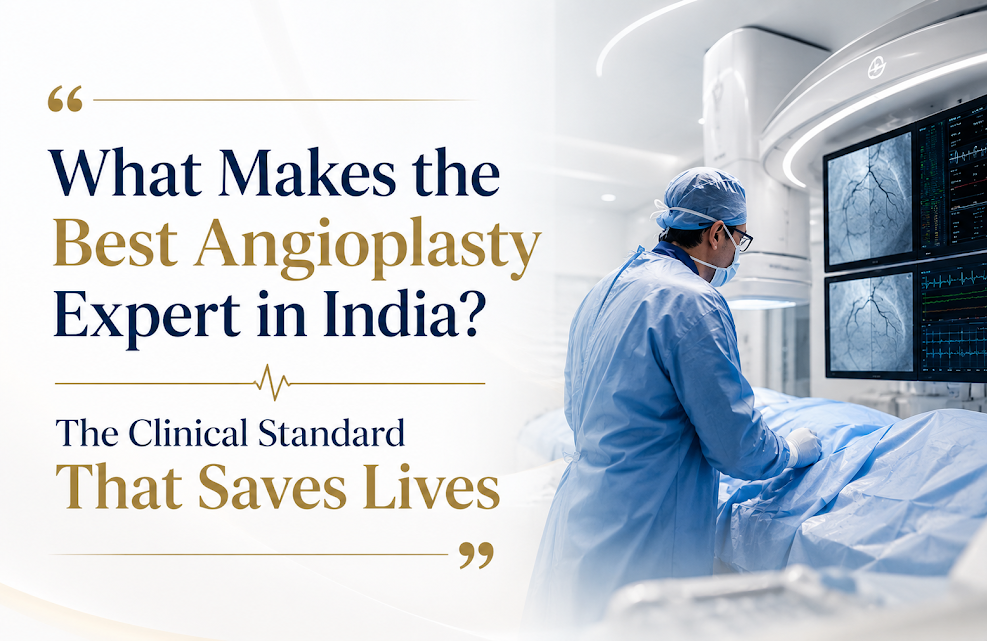
The outcome of that angioplasty, whether it relieves symptoms effectively, whether the stent lasts, whether the vessel stays open, or whether complications are managed safely, depends enormously on the quality of the operator. Not all interventional cardiologists are equal. The gap between the best angioplasty experts in India and average operators is meaningful, and that gap is most visible in exactly the cases where it matters most: complex lesions, challenging anatomy, and patients with multiple co-existing conditions.

This article explains what genuinely separates the best angioplasty experts in India from the rest — using plain language, grounded in evidence, because patients who understand these distinctions make better decisions about their own care.

What Coronary Angioplasty Actually Is

Coronary angioplasty, formally called Percutaneous Coronary Intervention (PCI) and historically known as PTCA (Percutaneous Transluminal Coronary Angioplasty), is a catheter-based procedure to open narrowed or blocked coronary arteries that supply blood to the heart muscle.

Under local anesthesia and light sedation, a catheter is inserted through the radial artery in the wrist (the modern preferred access route) or the femoral artery in the groin and navigated under X-ray guidance to the blocked coronary artery. A tiny balloon is inflated at the site of the blockage to compress the obstructing plaque and widen the artery. A PTCA stent  a small metal mesh cylinder  is then deployed at the same site to hold the artery open permanently.

Modern drug-eluting stents, which release medication over several months to prevent re-narrowing at the treated site, have dramatically improved the long-term success rates of coronary angioplasty. Complex cases involving heavily calcified plaques benefit from specialized techniques, including chip angioplasty using intravascular lithotripsy, cutting balloons, or rotational atherectomy, that the best angioplasty experts in Hyderabad are trained and equipped to deploy.

Also read : Meet Cardiologist in India, Dr C. Raghu Yashoda, Somajiguda 

Differentiator 1: Case Volume and Complexity Range

The relationship between operator volume and patient outcomes in interventional cardiology is one of the most extensively documented findings in all of medicine. Operators who perform a high annual volume of coronary angioplasty procedures make fewer technical errors, handle complications more adeptly, make better judgments about when to intervene and when not to, and produce measurably better outcomes across virtually every clinical metric.

This is particularly important in complex cases. Single-vessel, non-calcified, easily accessed coronary lesions in otherwise healthy patients are manageable for most trained interventionalists. Multivessel disease, chronic total occlusion recanalization, left main coronary stenting, severely calcified lesions requiring chip angioplasty techniques, and patients with prior coronary artery bypass surgery  these cases require accumulated experience that only comes with high-volume practice.

When a patient has complex coronary artery disease, the choice of a high-volume complex PCI operator is not a luxury. It is a clinical necessity that affects outcomes.

Differentiator 2: Intravascular Imaging Guidance

Coronary angiography — the standard X-ray imaging of coronary arteries using contrast dye — shows where narrowings are and how severe they appear. But it provides only a two-dimensional silhouette view of a three-dimensional structure. It cannot reliably assess plaque composition, calcium distribution, stent expansion, or stent apposition to the vessel wall.

Intravascular imaging — specifically intravascular ultrasound (IVUS) and optical coherence tomography (OCT) — provides cross-sectional views inside the artery in high resolution, allowing the angioplasty expert to see inside the vessel in three dimensions, choose the correct stent size, guide deployment, verify optimal expansion, and identify and correct problems before the patient leaves the catheterization laboratory.

Multiple large randomized trials and registry studies have confirmed that intravascular imaging-guided PCI is associated with lower rates of stent thrombosis, lower rates of target vessel failure, and better long-term clinical outcomes compared to angiography-guided PCI alone. An angioplasty expert in India who routinely uses intravascular imaging is practicing at a higher standard than one who relies on angiography alone.

Differentiator 3: Physiological Assessment of Lesion Severity

Not every coronary narrowing visible on an angioplasty and angiogram needs to be treated with a stent. Coronary angiography sometimes makes narrowings look more severe or less severe than they physiologically are. Treating a narrowing that does not cause ischemia (inadequate blood supply to heart muscle) with a stent exposes the patient to the risks of the procedure without providing clinical benefit.

Fractional Flow Reserve (FFR) and instantaneous Wave-Free Ratio (iFR) are wire-based physiological measurements that assess whether a coronary narrowing is causing clinically significant ischemia. Multiple trials — DEFER, FAME, FAME 2, and iFR-SWEDEHEART — have established that FFR- and iFR-guided PCI is superior to angiography-guided PCI in reducing unnecessary procedures while improving outcomes in lesions that truly require treatment.

A coronary heart disease doctor who uses physiological assessment to guide stent decisions is practicing evidence-based medicine at a higher standard than one who relies solely on the visual appearance of angiography.

Differentiator 4: Honest Decision-Making About When Not to Stent

Perhaps the most underappreciated quality of the best angioplasty experts in India is their willingness to recommend against angioplasty when the evidence does not support it. Major trials — ISCHEMIA, COURAGE, BARI 2D — have demonstrated that in patients with stable coronary artery disease and good left ventricular function, optimal medical therapy alone can produce outcomes equivalent to PCI for preventing heart attacks and death, while PCI reliably provides better symptom relief.

A coronary artery disease specialist who presents these findings honestly, explains that a stent will relieve angina but may not prolong life in stable disease, and supports the patient in making an informed choice rather than defaulting to the most immediately available intervention is providing genuinely excellent, patient-centered care.

This kind of honest decision-making is a marker of clinical confidence and integrity that patients should look for and value.

Also read: CHIP Angioplasty: Advanced Coronary Artery Disease Treatment Explained 

Emergency Angioplasty: The Time-Critical Dimension

The most time-sensitive application of coronary angioplasty is primary PCI the emergency procedure to open a blocked artery during an acute heart attack (STEMI ST-elevation myocardial infarction). Primary PCI must be performed within 90 minutes of hospital arrival to minimize heart muscle damage and improve survival. Every minute of delay costs irreplaceable cardiac muscle.

An angioplasty expert in Hyderabad who participates in a 24/7 primary PCI program on call around the clock, working in a center with rapid cath lab activation protocols, demonstrates the kind of commitment to acute cardiac care that defines a truly comprehensive coronary program. Dr. Raghu practice maintains this emergency PCI capability, ensuring that patients with acute coronary syndromes receive the most time-critical interventional care when it is needed most.

Dr. Raghu: The Standard of Excellence in Coronary Angioplasty in Hyderabad

Dr. C Raghu brings to his coronary angioplasty practice a combination of high case volume, routine intravascular imaging and physiological lesion assessment, mastery of complex PCI techniques, including chip angioplasty for calcified lesions, and an evidence-based communication approach that helps patients understand exactly when angioplasty adds value to their treatment and when other options deserve equal consideration.

His patients  from simple stable coronary disease to the most complex multivessel and chronic total occlusion cases — receive a consistently high standard of evaluation, procedural care, and long-term follow-up.

Contact Dr.C Raghu’s team cardiologist in Hyderabad through to schedule a coronary artery disease evaluation or angioplasty consultation.

About Dr. C. Raghu

Dr. C. Raghu — MD, DM, FESC, FACC, FSCAI
Interventional Cardiologist | Yashoda Hospital, Raj Bhavan Road, Somajiguda, 1st Floor, Room No. 115, Hyderabad – 500082, Telangana

Specialisation: Coronary, Vascular & Structural Interventions | TAVR | CHIP Angioplasty | Complex Coronary Procedures

OPD: Monday to Saturday, 8 AM – 8 PM  |  Emergency: 24/7  |  +91 95424 75650  |


Abhijit

PTCA-STENT-CORONARY-ANGIOPLASTY-EXPERT.webp

February 24, 2026

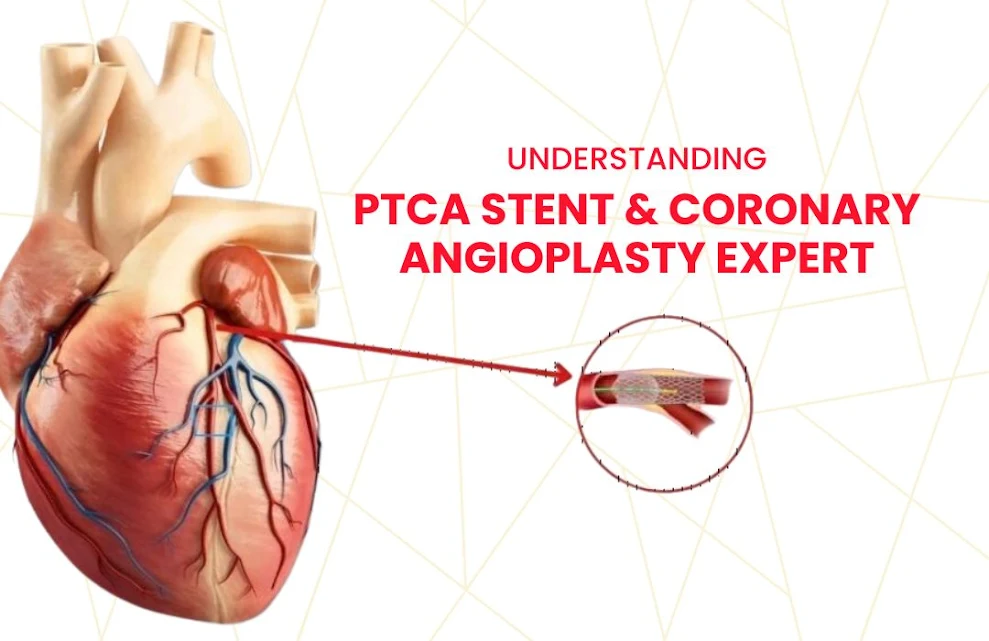
PTCA Stent जब किसी व्यक्ति को coronary artery disease (हृदय की धमनियों में रुकावट) के बारे में पता चलता है, तो चिंता होना स्वाभाविक है। धमनियों में ब्लॉकेज होने से हार्ट अटैक का खतरा बढ़ जाता है। ऐसे में एक अनुभवी coronary artery disease doctor या coronary artery disease specialist सही समय पर उपचार करके रक्त प्रवाह को सामान्य कर सकते हैं।

भारत में एक अनुभवी coronary heart disease doctor द्वारा की जाने वाली Coronary Angioplasty, Angioplasty in Heart, और PTCA Stent प्रक्रिया ब्लॉकेज को सुरक्षित तरीके से खोलने में मदद करती है। अगर आप Best Angioplasty Expert in India या Angioplasty Expert in India की तलाश में हैं, तो इस गाइड से आपको पूरी जानकारी मिलेगी।

PTCA Stent क्या होता है?

PTCA Stent एक छोटा जालीदार (mesh) ट्यूब होता है जिसे Angioplasty and Angiogram के दौरान ब्लॉक हुई coronary artery में डाला जाता है। इसका मुख्य उद्देश्य धमनियों को खुला रखना और दिल तक रक्त प्रवाह को सामान्य करना है।

आजकल भारत में Stent Coronary के उन्नत प्रकार जैसे Drug-Eluting Stent का उपयोग किया जाता है, जो दवा छोड़कर दोबारा ब्लॉकेज बनने से रोकता है। कई जटिल मामलों में आधुनिक तकनीक जैसे chip angioplasty का भी उपयोग किया जाता है।

Coronary Angioplasty क्यों की जाती है?

जब धमनियों में चर्बी (Plaque) जमा हो जाती है, तो उसे coronary artery disease कहा जाता है। इससे सीने में दर्द (Angina), सांस फूलना और हार्ट अटैक का खतरा बढ़ सकता है।

Coronary Angioplasty एक minimally invasive प्रक्रिया है जिसमें:

  • पहले Angioplasty and Angiogram द्वारा ब्लॉकेज की पहचान की जाती है
  • फिर एक बैलून कैथेटर के माध्यम से नस को खोला जाता है
  • आवश्यकता होने पर PTCA Stent या Stent Coronary लगाया जाता है
  • इस प्रक्रिया को आम भाषा में Angioplasty in Heart भी कहा जाता है।

प्रक्रिया और रिकवरी

  • सबसे पहले कार्डियक कैथेटराइजेशन किया जाता है।
  • एंजियोग्राम द्वारा ब्लॉकेज की जगह पता की जाती है।
  • बैलून फुलाकर नस को खोला जाता है।
  • जरूरत होने पर PTCA Stent लगाया जाता है।


अधिकांश मरीज 1–2 दिन में अस्पताल से छुट्टी पा लेते हैं। हालांकि, कुछ हफ्तों तक भारी काम से बचना चाहिए। सही दवाइयों और जीवनशैली में बदलाव से coronary artery disease को नियंत्रित रखा जा सकता है।


सही विशेषज्ञ कैसे चुनें?


एक अनुभवी coronary artery disease doctor या coronary artery disease specialists का चयन बहुत महत्वपूर्ण है। ध्यान रखें:

✔ डॉक्टर को Coronary Angioplasty और PTCA Stent में अनुभव हो

✔ अस्पताल मान्यता प्राप्त (Accredited) हो

✔ आधुनिक सुविधाएँ और कैथ लैब उपलब्ध हों

✔ मरीजों के अच्छे रिव्यू हों

यदि आप जटिल ब्लॉकेज के लिए Best Angioplasty Expert in India या अनुभवी Angioplasty Expert in India की तलाश में हैं, तो विशेषज्ञ का अनुभव और अस्पताल की सुविधाएँ सफलता दर को बेहतर बनाती हैं।


You can also read this : Angioplasty and Stent: Understanding the Link

Yashoda Hospitals में अनुभवी चिकित्सा स्टाफ प्रत्येक परामर्श के दौरान उन्हें उच्च गुणवत्ता वाली सहायता और रोगी-केंद्रित सेवाएँ प्रदान करता है। आज ही Dr. C. Raghu, जो हैदराबाद के एक अग्रणी हृदय विशेषज्ञ हैं, से अपनी अपॉइंटमेंट बुक करें और Yashoda Hospitals, Somajiguda में सुरक्षित और मजबूत हृदय स्वास्थ्य की दिशा में पहला कदम उठाएँ।


निष्कर्ष

coronary artery disease एक गंभीर स्थिति है, लेकिन सही समय पर उपचार और अनुभवी coronary heart disease doctor द्वारा की गई coronary angioplasty से मरीज सामान्य जीवन जी सकता है। हमेशा प्रमाणित अस्पताल में अनुभवी coronary artery disease specialists या Best Angioplasty Expert in India से परामर्श लें और अपने हृदय स्वास्थ्य को प्राथमिकता दें।


FAQs

  1. PTCA Stent क्या है?

यह एक जालीदार ट्यूब है जो Coronary Angioplasty के दौरान ब्लॉक धमनियों को खुला रखने के लिए डाला जाता है।

  1. Angioplasty and Angiogram में क्या अंतर है?

Angiogram ब्लॉकेज की जांच के लिए होता है, जबकि Angioplasty in Heart ब्लॉकेज को खोलने के लिए की जाती है।

  1. क्या chip angioplasty सुरक्षित है?

हाँ, यह जटिल और कठोर ब्लॉकेज में उपयोग की जाने वाली उन्नत तकनीक है।

  1. क्या Stent Coronary हमेशा जरूरी होता है?

अधिकांश मामलों में नस को खुला रखने के लिए PTCA Stent लगाया जाता है।

Abhijit

Angioplasty-After-a-Heart-Attack.webp

January 28, 2025

Angioplasty is a surgical intervention in which the occlusive/hypertrophied vessel or coronary artery of the heart is occluded by a balloon. This form of medical therapy is usually provided after myocardial infarction to restore arterialisation and shorten the course of damage. The surgeon puts a stent inside the lumen so that it stays patent in restoring blood flow. This early coronary angioplasty after myocardial infarction (within 3 months) also reduces future myocardial heart disease.

Abhijit

heat-attack-5.png

May 24, 2024

Heart attacks were once referred to as the old man’s disease. Earlier, they were associated with older individuals over 50. However, many speculations were made and brows were raised by the sudden demise of the ace actor Sidharth Shukla. It was soon followed by renowned singer KK and the comedian Raju Srivastava. All three of them succumbed to cardiac complications.

Abhijit


Dr raghu logo


Dr raghu logo


Call us now if you are in a medical emergency need, we will reply swiftly and provide you with a medical aid.


For Appointment with Dr Raghu: +91 80085 36699
Dr Raghu’s Patient Coordinator: +91 72860 10203
Dr Raghu’s Office Experience: +91 90001 65962
Dr Raghu’s Social Media Communication Channel: +91 97046 51708

Dr. Raghu | Heart Specialist in Hyderabad
Yashoda Hospitals, Raj Bhavan Road, Somajiguda, 1st floor, Room No. 115, Hyderabad -500082, Telangana

Best Cardiologists in Hyderabad


© 2024, Dr. Raghu. All rights reserved. Design & Developed by AMSDigital.in

[gtranslate]
+91-9542475650