
heart-attack.jpg

June 6, 2026

Heart doctor in Hyderabad are increasingly seeing a troubling trend among younger adults. You are 34, a non-smoker, not diabetic, and seemingly fit. You hit the gym three times a week and eat reasonably well. And then one Tuesday morning, mid-workout, your chest tightens. By the time the ambulance arrives, you are having a massive cardiac event. This is not a rare story anymore. Heart attacks in young people — in their 30s and early 40s — are rising at a rate that has even the most seasoned Heart Specialist in Hyderabad concerned. 

India’s Young Heart Problem Is Real

India has one of the highest rates of premature heart disease in the world. Studies show that nearly 25% of all heart attack deaths in India occur in people under 40. This is not genetics alone. This is a lifestyle crisis. The Indian urban professional is under enormous pressure — career targets, long commutes, rising EMIs, social comparison on Instagram, and a food culture that has quietly shifted from home-cooked dals and rotis to Zomato orders every other night.

Also read: Best Heart Doctor in Hyderabad, Why Dr C Raghu 

Why a Heart Attack at the Gym Is More Common Now

A heart attack in gym settings among young people is not because exercise is dangerous. It is because people with undetected arterial plaque push their hearts into maximum exertion without ever being screened. When you sprint on a treadmill with a partially blocked artery, the sudden surge in demand can rupture that plaque. The resulting clot blocks blood flow — that is a heart attack.

A famous cardiologist in India, like Dr C. Raghu, sees this pattern regularly — young patients who looked completely healthy on the outside but had arteries that were silently narrowing for years. Consulting a trusted top heart specialist in Hyderabad before symptoms appear is the most effective form of prevention.

What Is a Silent Heart Attack?


A silent heart attack causes minimal or no symptoms. You might feel a bit tired for a few days. Some mild jaw, upper back, or arm discomfort. A passing nausea. And then you go back to work. It can cause permanent damage to your heart muscle without you even knowing it happened — often only showing up when you get an ECG for an unrelated reason.

What Is a Minor Heart Attack?

A minor heart attack — medically called an NSTEMI — is often dismissed as indigestion or stress. But it still injures your heart. Each one increases your risk of a more severe event. Any cardiac event is a medical emergency. Time is muscle.

The Lifestyle Changes That Actually Matter


Stop Treating Weekdays as a Write-Off

Your coronary arteries do not work on a Monday-to-Friday write-off schedule. Chronic inflammation from daily junk food, late nights, and inactivity builds the plaque that eventually ruptures.

Understand Your Family History

If your father had a heart attack at 50 or your uncle was on cardiac medication at 45, your risk is significantly higher. This is not destiny — it is a warning to act earlier. Tell your heart doctor in Hyderabad about your family history at every visit.

Get a Cardiac Screening, Not Just a General Health Check

A standard corporate health check measures your weight, blood pressure, and blood sugar. A proper cardiac screening includes an ECG, echo, lipid profile, and sometimes a treadmill stress test — giving a far more complete picture of your heart’s actual health.

Balloon Mitral Valvotomy: When Valve Disease Enters the Picture

Some young Indians — especially women with a history of rheumatic fever — develop valve problems that mimic heart disease symptoms. Balloon Mitral Valvotomy is a minimally invasive procedure used to treat mitral valve stenosis, which can cause breathlessness and fatigue identical to what many young professionals attribute to being out of shape.

Also read: Atrial Fibrillation treatment in India: Complete Guide 

Conclusion

Your heart does not care that you are 34 and busy. If you are an urban professional living a high-pressure, low-movement life, the time to act is right now — not after a cardiac event.

Dr C. Raghu — Interventional Cardiologist, Yashoda Hospital, Somajiguda, Hyderabad
Recognized widely recognised as a famous cardiologist in India for his expertise in complex coronary interventions and preventive cardiology. He has helped young patients across Hyderabad, Bangalore, and beyond reclaim their heart health before a crisis arrives.
 

Abhijit

Coronary-Artery-Disease-in-India.jpg

May 15, 2026

Coronary artery disease (CAD) kills more Indians than any other single condition. It strikes earlier in the Indian population than in Western countries, often a decade sooner,  driven by a combination of genetic susceptibility to dyslipidemia and insulin resistance, high rates of diabetes, rising rates of obesity and physical inactivity, tobacco use, and a diet increasingly influenced by processed food.

Yet the treatment available today — when coronary artery disease is detected early enough and managed by a skilled coronary artery disease specialist — is remarkably effective. Coronary angioplasty in heart arteries, supported by modern drug-eluting stents and evidence-based medication, gives patients with even severe coronary disease a very real path back to normal life.

The barrier is not treatment availability. It is awareness: patients who do not know the symptoms, who dismiss warning signs, or who do not understand what a coronary angioplasty and angiogram involve delay seeking help in ways that cost them heart muscle, cardiac function, and, sometimes, their lives.

This guide walks every reader through the complete pathway from recognizing symptoms through the diagnostic angiogram to PTCA stent placement and recovery—because understanding this pathway is genuinely life-saving.

Also read: Understanding PTCA Stent & Coronary Angioplasty expert

What Happens in Coronary Artery Disease

coronary artery disease

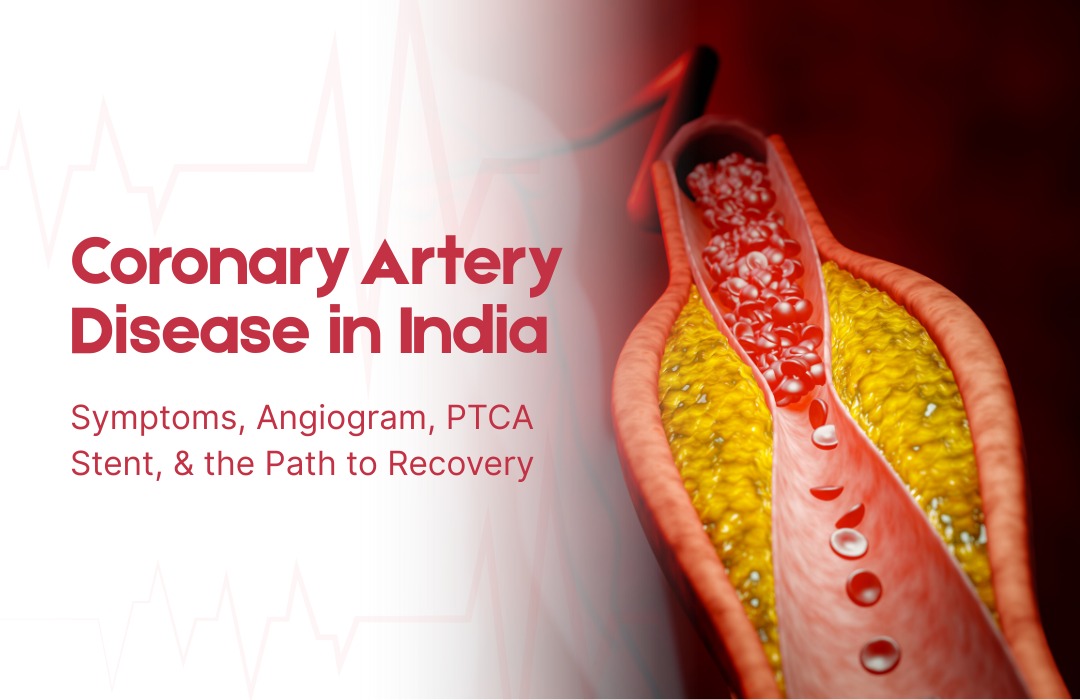
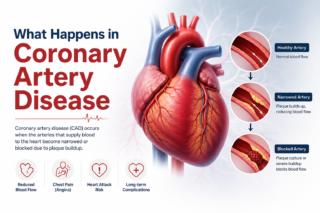
Coronary arteries are the three main blood vessels that supply oxygenated blood to the heart muscle itself. Coronary artery disease is the progressive accumulation of atherosclerotic plaque deposits of cholesterol, inflammatory cells, calcium, and connective tissue within the walls of these arteries. As plaques grow, they narrow the artery’s lumen, reducing the volume of blood the heart muscle receives.

In early disease, there are no symptoms. As narrowings become significant, the heart muscle receives adequate blood at rest but insufficient blood during exertion, producing the symptom of stable angina. When a plaque ruptures suddenly, as can happen without warning at any level of physical exertion, it triggers the formation of an acute blood clot that can completely block the artery, causing a heart attack 

Heart attacks cause permanent heart muscle damage in proportion to the time the artery remains blocked. Opening the blocked artery within 90 minutes of symptom onset with emergency coronary angioplasty (primary PCI) salvages the most muscle and produces the best survival outcomes. Every minute matters.

Recognising the Symptoms: What to Know, and What to Take Seriously

Stable angina is exertional chest discomfort—a tightness, pressure, heaviness, or aching in the center of the chest that appears predictably during physical activity (walking uphill, climbing stairs, carrying loads) and relieves with rest within a few minutes. It may radiate to the left arm, jaw, or back.

In the Indian population, and particularly in patients with diabetes, coronary artery disease sometimes presents atypically without classic chest pain,but with unexplained breathlessness on exertion, unusual fatigue, or a feeling of heaviness or indigestion. These symptoms in any patient with cardiovascular risk factors deserve a prompt cardiac evaluation, not reassurance.

Acute coronary syndromes,  unstable angina and heart attack, present with chest discomfort that is more severe and longer-lasting (more than 20 minutes) and may occur at rest. Associated symptoms, including sweating, nausea, breathlessness, or syncope, increase the likelihood of an acute event. These symptoms require immediate emergency care calling an ambulance and going directly to the nearest hospital capable of emergency coronary angioplasty in heart arteries.

The Diagnostic Pathway: From Symptom to Angiogram

The investigation of stable chest pain begins with clinical history, examination, a resting ECG, and blood tests. An echocardiogram assesses left ventricular function and wall motion. Stress testing exercises, ECG, stress echocardiogram, or nuclear perfusion imaging demonstrates whether coronary disease is causing ischemia during physical stress.

When an investigation suggests significant coronary artery disease, or when a patient presents with an acute coronary syndrome, coronary angiography is performed. This angioplasty and angiogram procedure takes 20 to 40 minutes under local anesthesia and sedation, with a catheter inserted through the radial artery in the wrist to deliver contrast dye into the coronary arteries while X-ray images map the distribution and severity of narrowings.

CT coronary angiography, a noninvasive alternative using CT scanning, is increasingly used as an initial anatomical investigation in stable patients with intermediate pretest probability of significant coronary disease, providing detailed arterial mapping without catheter insertion.

Also read: 5 Signs You or Your Elderly Parent May Need a Heart Valve Replacement  

PTCA Stent: What the Procedure Involves Step by Step

When the angiogram reveals a narrowing that warrants treatment, angioplasty with PTCA stent deployment proceeds as follows:

A guidewire, a very thin, flexible wire, is advanced through the catheter and across the coronary narrowing. The wire serves as a rail for all subsequent equipment. A balloon catheter is advanced over the wire to the lesion site and inflated to compress the plaque, widening the arterial lumen. A drug-eluting stent coronary device, a metal mesh cylinder mounted on a second balloon, is then advanced to the same position and expanded, embedding itself in the artery wall and remaining in place permanently as a scaffold.

After stent deployment, the operator assesses the result using post-deployment balloon inflation to optimize expansion and intravascular imaging (IVUS or OCT) in many cases to confirm optimal stent apposition. Haemodynamic measurements confirm normal blood flow before all equipment is removed.

For heavily calcified lesions that require special preparation before stenting, chip angioplasty techniques, including intravascular lithotripsy or rotational atherectomy, are deployed to modify the calcium and allow adequate stent expansion.
The entire procedure for a straightforward single-vessel case typically takes 45 to 90 minutes.

Recovery: Life After a Coronary Stent

Recovery from coronary angioplasty is rapid compared to surgical alternatives. Most patients return to light daily activities within one to two weeks and to full activity within two to four weeks.

The most critical post-stent requirement is medication adherence. Dual antiplatelet therapy, aspirin combined with a second agent (clopidogrel, prasugrel, or ticagrelor), is prescribed for a defined period to prevent stent thrombosis. The duration depends on stent type and clinical risk profile. Stopping this medication early without medical guidance carries a risk of acute stent occlusion and must be avoided.

Long-term coronary artery disease management, statins, blood pressure treatment, diabetes optimization, and lifestyle modification continue indefinitely regardless of whether a stent has been placed. A stent treats the obstruction; it does not cure the underlying disease. Regular follow-up with the treating coronary artery disease doctor is essential for monitoring disease progression and adjusting treatment as needed.

Dr. C Raghu: Comprehensive Coronary Artery Disease Care in Hyderabad

Dr. C. Raghu coronary artery disease program in Hyderabad encompasses the full clinical pathway from initial risk assessment and non-invasive investigation through coronary angiography and complex coronary angioplasty to long-term secondary prevention management. His practice uses intravascular imaging and physiological assessment tools routinely, reflects current evidence-based guidelines in every decision, and provides clear, patient-centered communication throughout every stage of the diagnostic and treatment process.

For advanced coronary artery disease treatment, coronary angioplasty, and PTCA stent care in Hyderabad, consult Dr. C. Raghu at Yashoda Hospitals, Secunderabad — Call +91 95424 75650 today for expert cardiac care.


Abhijit

Cardiologist-in-India-Dr-C.-Raghu.jpeg

December 9, 2025

Best Cardiologist in India – Your heart health should never be ignored.
You live a busy life. You move faster than your heartbeat. Every day, you wake up to responsibilities, deadlines, family duties, and the silent pressure to stay strong. But somewhere inside, you feel a small fear. A sudden chest discomfort. A heartbeat that races without reason. A tiredness you ignore. You tell yourself it’s nothing. Yet the worry stays. And this is exactly what many urban middle-aged readers silently live with. You ignore heart attack symptoms, hoping they will disappear on their own. But the truth is simple: your heart keeps sending signals, and you keep silencing them.

You face this problem because your life never slows down. But someday, when you finally have to check, you try by visiting Google and using its search for cardiologists in Hyderabad, or by asking someone about the best cardiologist in Hyderabad they may be aware of. You look for someone who listens like a well-wisher, not just a doctor. Someone who explains things in simple, everyday language. Someone who gives you confidence

This is where you should consult Dr C. Raghu at Yashoda Hospital, Somajiguda

Why You Should Pay Attention to Your Heart Today

Your lifestyle creates a quiet storm inside your body. You may not see it. But your heart feels it.

Here are the consequences many people face when they delay heart care:

  • You ignore signals like chest pressure, fatigue, and breathlessness.
  • You treat acidity as chest pain and chest pain as “just stress.”
  • You let blockage grow until it becomes an emergency.
  • You trust random online advice instead of a qualified cardiologist Hyderabad.
  • You rush to a hospital only when the situation becomes scary.

And once a heart issue reaches an advanced stage, your life changes overnight. Your family panics. Your routine breaks. Your savings take a hit. Worst, your confidence shakes.

But here is the good part—you can prevent this. You can take control today. You can meet the right doctor at the right time. You can understand your symptoms instead of ignoring them.

Meet Dr C. Raghu – Top Cardiologist & TAVI/TAVR Expert in Hyderabad 

You come across many names when you search for the Top cardiologist in Hyderabad. Out of all the names, choose Dr C. Raghe. With 25+ years, he is known for his expertise. He understands your problems. You feel he listens to your story before touching reports. He will make you feel comfortable and explain your reports 

He is a Senior Director and interventional cardiologist at Yashoda Hospital, Somajiguda, one of the most trusted facilities for advanced cardiac care in Hyderabad.

What makes him different?

  • He speaks in simple words.
  • He explains what is happening inside your heart.
  • He gives clarity instead of confusion.
  • He focuses on prevention, not just treatment.
  • He guides you like he is guiding a family member.
  • He tells you lifestyle corrections that actually work.

His goal is simple—to help you live a longer, healthier, and more confident life.

What You Experience When You Visit Him

When you enter Yashoda Hospital, Somajiguda, you do not feel lost. The environment is calm. The staff is helpful. And once you sit in front of Dr. Raghu, you feel relaxed.

He looks at your symptoms.
He listens to your routine.
He asks about your stress.
He checks your reports with attention.
He explains what each test means.

You understand your heart better in just one consultation.

If you are searching for a cardiologist in Hyderabad or worried about heart attack symptoms, his approach gives immediate clarity.

The Emotional Touch in His Care

Even though he works in a major city hospital, Dr C Raghu keeps a simple approach, something we often see in rural communities—warmth, honesty, and direct guidance.

He uses this style to help you:

  • Understand your heart like a human, not like a machine.
  • Fit lifestyle changes into your daily routine.
  • Reduce fear through easy explanations.
  • Build confidence slowly and steadily.

He believes good health is not just about treatment—it is about awareness, understanding, and daily discipline.

How You Can Solve Your Heart-Related Problems

You do not need to panic. You only need a roadmap. And here is a simple one:

  1. Listen to your symptoms

Do not ignore:

  • Chest pain
  • Sudden sweating
  • Unusual fatigue
  • Breathlessness
  • Left arm or jaw pain
  • Dizziness

These are classic heart attack symptoms, and they need attention.

  1. Consult the right expert

Choose a specialist who deals with cardiac issues every day.
Choose a name trusted by thousands.
Choose someone who explains, not complicates.

  1. Start preventive habits
  • Walk daily
  • Eat home-cooked food
  • Sleep enough
  • Reduce stress
  • Keep tests updated
  1. Visit the hospital before an emergency

A timely consultation can save you from a lifetime of regret.

If you are still unsure whom to consult, the answer is simple—schedule a visit with Dr C. Raghu at Yashoda Hospital, Somajiguda.

Why Many Consider Him the Best Cardiologist in Hyderabad

Because he brings:

  • Skill
  • Experience
  • Compassion
  • Clarity
  • Trust

And most importantly, he gives you the confidence to take control of your heart health.

People from across Telangana, Andhra Pradesh, and even rural India visit him because they feel heard. They feel understood. They feel cared for.

You can also read this:- TAVR/TAVI Procedure in Hyderabad Minimally Invasive Care

A Small Message From One Human to Another

Your heart is not a machine.
It is a story.
Your story.

 It carries your stress, your dreams, your struggles, your hopes.
Do not wait for a big scare to value it.
Do not wait for pain to seek help.
You deserve good health.
You deserve peace.

And it starts with meeting the right specialist.

Closure

 You now know the risks.
You now know the consequences.
You now know the solution.

So take the next step today.

Meet Dr C. Raghu, senior interventional cardiologist at Yashoda Hospital, Somajiguda.
Your heart will thank you.

Call  → +91 95424 75650
Get Direction

Abhijit


Dr raghu logo


Dr raghu logo


Call us now if you are in a medical emergency need, we will reply swiftly and provide you with a medical aid.


For Appointment with Dr Raghu: +91 80085 36699
Dr Raghu’s Patient Coordinator: +91 72860 10203
Dr Raghu’s Office Experience: +91 90001 65962
Dr Raghu’s Social Media Communication Channel: +91 97046 51708

Dr. Raghu | Heart Specialist in Hyderabad
Yashoda Hospitals, Raj Bhavan Road, Somajiguda, 1st floor, Room No. 115, Hyderabad -500082, Telangana

Best Cardiologists in Hyderabad


© 2024, Dr. Raghu. All rights reserved. Design & Developed by AMSDigital.in

[gtranslate]
+91-9542475650